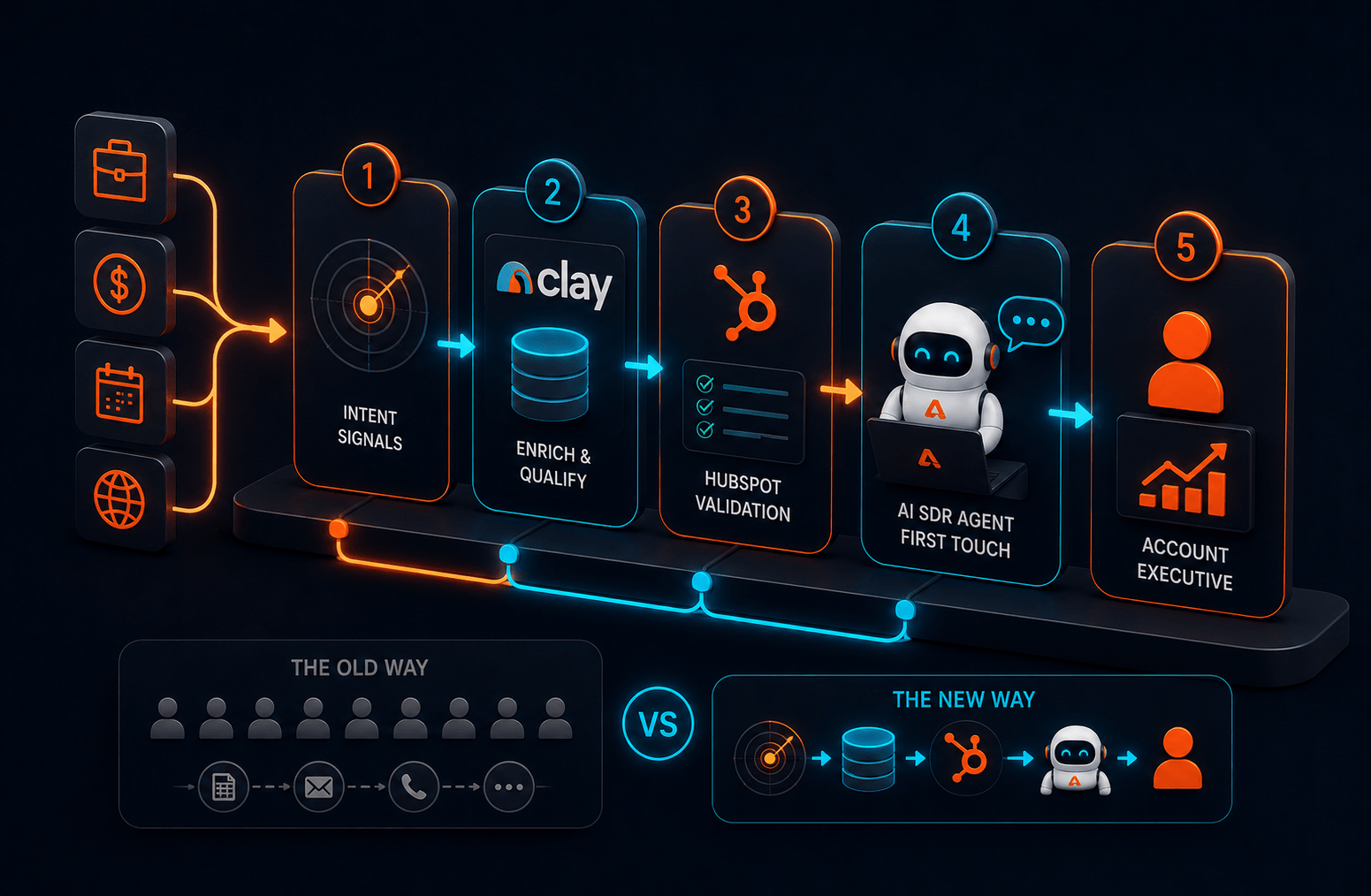

Why Your Outbound System Still Doesn't Convert
Maybe you've already built the outbound system. You track signals, enrich leads, automate workflows, and use AI to scale faster. But it is still not converting the way it should.
Here is why: Most teams invest in technology and forget about strategy. But technology built on top of a missing strategy does not fix the problem. It scales it. The clients who've used this system have closed CHF 800k in pilots within 12 months — not because they had better tools, but because strategy and technology finally worked together.
If your system lacks familiarity, ICP clarity, and a truly valuable offer, you are not scaling your pipeline. You are scaling what is not working.
Buyers spot cold outreach immediately. Signals can tell you when to reach out. AI can help you do it faster. But without trust, relevance, and the right offer, it still gets ignored.
That is what our 7-Figure GTM System is built to do: create familiarity before activation, validate the right signals against the right buyers, and turn them into pipeline with offers that actually matter.
At a high level, this system moves through three layers: familiarity → validation → activation. Below, we break down the 5 steps we use to build it in practice:
5 Steps to Build Your 7-Figure GTM System
- Step 1: Build Authority & Familiarity
- Step 2: Track Intent Signals
- Step 3: Validate + Enrich
- Step 4: Choose the Right Conversion Strategy + Offer
- Step 5: Activate
Step 1: Build Authority & Familiarity

Everyone is competing for attention. Everyone is tracking signals, personalizing outreach, and using AI to scale faster. So what actually makes you stand out?
Not another tailored opener. It's familiarity.
If the right buyers have already seen your name, your perspective, or your content before the first message lands, outreach performs differently. Recognition creates context, lowers resistance, and makes your brand feel more credible from the start.
That is why familiarity is a core part of the system, not a nice-to-have. It builds trust before activation and strengthens everything that follows.
How to build it in practice
1. Auto-connect with the right buyers
- Define the ICP and buyer groups you want to be visible to
- Use tools like GetSales to automate connection requests at scale
- Auto-remove old pending invitations regularly to maintain your LinkedIn health
2. Build a repeatable content system
- Build a content engine that helps you publish consistently and sharpen your point of view
- Use a setup like Claude Code, which learns from your past posts and drafts new content in your voice
- Use it to generate drafts in your voice and target 2–3 posts per week
3. Comment where your buyers already pay attention
- Build a list of influencers, creators, and operators your ICP already follows
- Use a Clay table to track their latest LinkedIn posts
- Filter for relevant, high-engagement posts
- Use AI to draft comments that deliver real value: a specific insight, a step-by-step example, or a contrarian take
- Post via PhantomBuster directly from the table
- Do not underestimate this step. Commenting on the right posts, with the right perspective, drives as much visibility as posting itself. Sometimes even more.
Tools: LinkedIn / GetSales / Clay / Claude Code / OpenAI / PhantomBuster
Why it matters: Familiarity creates trust before activation.
💡 TIP: Don't try to build familiarity with your entire market at once. Start with a focused beachhead: a specific ICP segment where you can become genuinely recognisable. A tight audience that knows your name beats a broad audience that doesn't.
❌ DON'T: Skip the familiarity layer because it feels slow. Teams that jump straight to activation without it pay the price in lower reply rates, more ignored messages, and longer sales cycles. The market is too saturated for cold outreach to carry the whole load.
Example
LinkedIn Commenting System
Step 2: Track Intent Signals

Familiarity makes outreach stronger. Signals make it timely.
Once your brand is visible to the right buyers, the next step is to identify when a relevant conversation becomes more likely. Signals help you spot changes in behavior, role, company situation, or market timing that make outreach more relevant right now.
But not every signal matters equally. The goal is not to collect as many triggers as possible. The goal is to track the signals that actually indicate interest, change, or potential need.
How to build it in practice
1. Define the signals that actually matter
Start by listing the moments in your ICP's journey that could indicate a need or a change:
- A new hire
- A funding round
- A job change
- A news mention
- A website visit
- A post engagement
Then narrow it down: Which of these signals are most relevant to what you sell and who you sell to?
2. Centralize everything in Clay
- Use Clay's native LinkedIn integration to track job changes, new hires, and company updates directly
- Add PhantomBuster for more advanced scraping like post engagement, comments, and event participation
- Use tools like Leadfeeder to identify companies visiting your website
- Configure each source to push data automatically into Clay as signals happen
Tools: LinkedIn / PhantomBuster / Leadfeeder / API & Webhooks / Clay
Why it matters: Signals tell you when to act, but only the right signals create better timing.
Example:
Monitor Job Change of Champions
Want to see the full guide? Read it here.
Step 3: Validate + Enrich

Most teams enrich for the sake of having more data. That leads to activating the wrong accounts and burning goodwill with contacts who were never a fit.
Signals alone are not enough. Before you activate, you need to know whether the account actually fits your ICP, whether the contact fits your buyer persona, and whether the opportunity is clean.
That is why validation and enrichment sit at the core of the system. We do not enrich for the sake of having more data. We enrich to decide whether this account and this person are actually worth acting on
How to build it in practice
1. Collect the right account and buyer data
- Use Clay to enrich key account data like employee size, funding, location, founding year, and industry
- Enrich buyer-level data like job title, seniority, department, and role relevance
- Keep everything in one place so fit can be evaluated consistently
2. Apply an ICP and buyer fit formula
- Score whether the company matches your ICP and whether the contact fits the buyer persona you want to reach
- Only move forward if both the account and the person are a strong fit
3. Check HubSpot before you activate
- Deduplicate against HubSpot to see whether the company or contact already exists
- Exclude active opportunities, existing customers, and recent outreach
- Only activate if there has been no contact in the last 3 months
Tools: Clay / HubSpot / OpenAI
Why it matters: Clay enriches, scores, deduplicates against HubSpot, and prioritises. Only the right accounts and contacts are pushed to the next step.
💡 TIP: Build a simple ICP fit formula directly in Clay. Assess each account based on the criteria that matter most to you: funding stage, employee size, industry, region, and any other filters relevant. Every account that enters your system gets assessed automatically.
❌ DON'T: Skip the HubSpot deduplication step. One of the fastest ways to damage a key relationship is to send outreach to an existing client or an active opportunity. Build the check into the workflow from day one — not as an afterthought.
Example:
Enrich the needed information & dedupe against HubSpot directly in Clay:

Step 4: Choose the Right Conversion Strategy + Offer

This is where most teams get it wrong.
They detect a signal, mention the trigger, hyper-personalize the opener, and assume that will do the job. It doesn't. Because everyone is doing the same thing, and the buyer immediately reads it as just another outbound message.
That is not a conversion strategy. That is just a slightly better cold message.
If you want real performance, you need to choose the right strategy based on your ACV, your solution complexity, and the level of trust your buyer needs before engaging. Then you need to pair that strategy with an offer that feels genuinely valuable on its own.
How to build it in practice
1. Match the strategy to the deal size
- Low touch / ACV <$10k: volume + demand capture, lower CAC as much as possible — free value, lead magnets, show-not-tell, community/group selling
- Medium touch / $10k < ACV < $100k: more tailored value, stronger proof, targeted offers
- High touch / ACV >$100k: indirect trust-building motions like interviews, roundtables, event campaigns, or market studies
2. Use a high-value offer, not just a sales ask
- Do not default to "book a call"
- Choose an offer that fits the buyer, the problem, and the trust required
- Make the offer valuable enough that it stands on its own, even without the sales pitch behind it
3. Build from proven conversion plays
- Standardize the strategies that already work by buyer persona, ACV, and offer type
- Reuse them instead of reinventing the motion every time
- Let AI support execution, but not replace strategic thinking
Why it matters: Generic personalization does not create conversion. The right strategy and a high-value offer do.
Example (Low ACV / Show-not-tell):
We scraped 500 target companies in the insurance sector and used an automated email to show part of the data directly in the message. Instead of asking for a call, we offered the full list for free.
Why it worked:
It proved the value before asking for anything.

Example (High ACV / High Value):
For larger deal sizes and complex solutions, we invite decision-makers from our ICP to exclusive round tables on highly relevant topics. Participation requires a short interview call first, which turns the motion into a hidden discovery call.
Why it worked:
Exclusivity + relevance + built-in trust.
Result:
60–70% positive reply rate among cold CEOs, and 30% converted into a follow-up demo before the event.

Step 5: Activate

This is where the system pays off. By the time a lead reaches this step, Clay has already enriched it, validated the ICP fit, and determined the right strategy and offer. All that is left is activation. The lead gets pushed automatically into the right campaign, on the right channel, with messaging that is already tailored to the signal and the offer.
How to build it in practice
1. Route leads to the right campaign automatically
- Based on the ICP, the signal, and the offer type, Clay pushes each lead directly into the right campaign in Instantly or GetSales
- No manual sorting, no copy-pasting leads between tools
- Every lead enters the sequence that was built specifically for their profile and situation
2. Choose the right channel
- Use email for higher-volume motions and when the buyer is harder to reach on LinkedIn
- Use LinkedIn for more personal, direct outreach where the relationship matters more
- Combine both when visibility and response rates justify it, but be aware that LinkedIn sequences take more time to manage and have stricter limits
- Let the signal and the ICP guide the channel choice, not habit
3. Let the system run
- Sequences are triggered, followed up, and completed automatically based on the rules you defined
- Your team focuses only on positive replies and the conversations that matter
- For teams that want to go further, a response manager built with Claude Code can automatically send meeting links and handle follow-ups until a meeting is booked — so your team only steps in for the SQLs
Tools: Instantly / GetSales / Lemlist
Why it matters: By the time a message lands, it is already the right message, to the right person, on the right channel. Your team does not manage the process. They only show up for the conversations that matter.
What You Can Achieve If Done Right
You now have the full system. It works when the right buyers already know your name before the first message lands. When you only activate accounts that actually fit. And when the offer you bring is valuable enough to earn a response on its own.
Three layers. One system where strategy and technology work together from the start.

Real results from clients who built this system within 12 months:
- +40% positive reply rates
- 400+ calls booked
- CHF 800k closed won in pilots
- LTV of CHF 8M
This is what happens when the right strategy and the right technology work together as a system.

Most teams try to fix a strategy problem with a new tool or a technology problem with a new hire. Neither works. The teams that win are the ones who stop treating these as separate problems and build a system where strategy and technology work together from the start.
That is what we build at Peakora. And we would love to build it with you.
Ready to get started?
In this session, we will:
- Identify your known and unknown challenges that hinder you from growing your business.
- Get solutions to your problems from GTM experts who’ve scaled high-growth B2B companies.
- Develop a 3-Step action plan that will get you results over the next 90 days.