
Why Enterprise Sales Teams Need Account Intelligence
Enterprise fintech deals are rarely won because someone sent the best cold email.
They are won because the sales team understands what is actually happening inside the account.
When selling into banks, fintechs, or large SaaS platforms, deals often take 6–18 months and involve multiple stakeholders across:
- product
- payments
- risk
- compliance
- partnerships
- technology
During that time, the internal dynamics of the account constantly change. New executives join. Product initiatives evolve. Budgets shift. Internal champions gain or lose influence.
Historically, keeping track of these changes required significant manual effort.
Today, AI allows sales teams to monitor these signals continuously and at scale, going much faster than ever before.
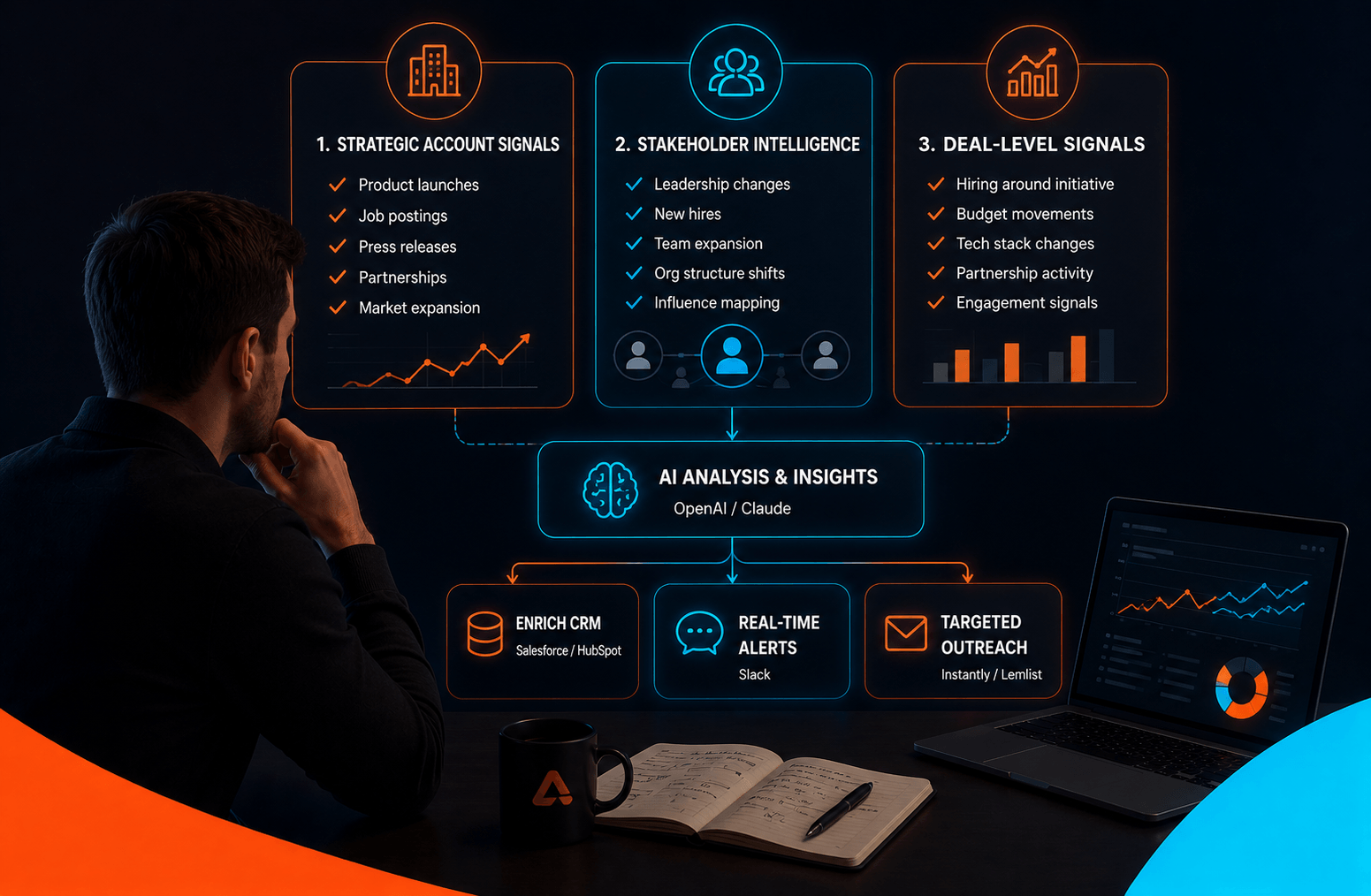
The most effective teams combine human account strategy with AI-powered intelligence across three layers.
The Intelligence Framework
To build a solid intelligence framework, you need to consider 3 elements:
- Strategic Account Signals
- Stakeholder Intelligence
- Deal-Level Signals

Together these layers help sales teams understand:
- where buying cycles may emerge
- who is driving decisions inside the organization
- how deals are evolving internally
Before 2025, this was all done manually, or with the use of limited technologies, such as 6sense. Entire BD teams were hired to continually enrich data, and help sales teams utilise.
Now, AI can help sales teams monitor and enrich strategic accounts across these areas.
1. Strategic Account Signals
Understanding What the Company Is Trying to Achieve
Many fintech buying cycles begin when companies launch new products, expand into new markets, or modernize infrastructure.
Examples include:
- a SaaS platform launching embedded financial services
- a bank investing in payments modernization
- a fintech expanding into new regulated markets
- a platform launching merchant lending products
These initiatives often create demand for new:
- technology partners
- infrastructure providers
- strategic partnerships
❗Example: Embedded Lending Initiative
Imagine a vertical SaaS platform begins hiring for roles such as:
- Product Manager – Embedded Lending
- Credit Risk Data Scientist
- Partnerships Manager – Capital Providers
This hiring pattern strongly suggests the company is preparing to launch a lending product for their customers.
That initiative may require:
- lending infrastructure
- credit decisioning systems
- capital providers
- compliance tooling
Imagine a vertical SaaS platform begins hiring for roles such as:
- Product Manager – Embedded Lending
- Credit Risk Data Scientist
- Partnerships Manager – Capital Providers
This hiring pattern strongly suggests the company is preparing to launch a lending product for their customers.
That initiative may require:
- lending infrastructure
- credit decisioning systems
- capital providers
- compliance tooling
How to Monitor These Signals
Tools like Clay can monitor signals across your target accounts including:
- company blogs
- job postings
- press releases
- product announcements
- Sales Conversations
Once captured, OpenAI or Claude (Anthropic) can analyze the content and determine:
- what initiative the company is launching
- which teams are likely involved
- whether the signal aligns with your solution
This allows sales teams to identify accounts entering potential buying cycles earlier. Without this, timing becomes a challenge, and you are blindly prospecting.
2. Stakeholder Intelligence
Understanding Who Is Driving Change
Enterprise fintech deals rarely depend on a single decision maker. In fact, I cannot think of any deal that depends solely on one person’s decision. Multiple stakeholders, through a magnitude of complexity, are continually being involved.
Influence constantly shifts inside organizations.
People join the company.
Others get promoted.
New teams are formed.
Tracking these movements helps sales teams understand who is shaping decisions inside the account.
❗Example: New Head of Payments
Suppose a mid-sized bank hires a new Head of Payments from a high-growth fintech.
This person was likely hired to:
- modernise the bank’s payment infrastructure
- launch new payment capabilities
- reassess existing technology vendors
That leadership change may create a window where the organization is more open to evaluating new solutions.
Now if it were reversed, and a payment startup had hired an incumbent executive, you’d interpret this as the business needing either more credibility or stability.
How AI Helps Monitor Stakeholders
Tools like Clay can detect leadership changes across your strategic accounts.
Once identified, OpenAI or Claude can summarize the stakeholder’s background, including:
- previous companies
- technology environments they worked with
- product initiatives they helped launch
This allows sales teams to quickly understand the perspective and priorities of new stakeholders.
3. Deal-Level Signals
Understanding Whether Momentum Is Increasing or Decreasing
Once a deal is active, intelligence should become more focused.
Sales teams want to understand whether the initiative connected to their deal is gaining internal momentum. Additionally, it will help sales teams know where to focus, and spend their time.
❗Example: Hiring around an Initiative vs A Project.
Hiring Around an Initiative
If a fintech begins hiring for roles such as:
- Lending Operations Lead
- Credit Risk Analyst
- Partnerships Manager – Capital Providers
...that usually indicates the lending initiative is accelerating internally.
Hiring activity around a project often signals:
- budget allocation
- executive support
- increasing internal resources
Other Deal Signals
Signals that may indicate deal momentum include:
- partnership announcements
- technology vendor changes
- executives discussing the initiative publicly
- internal team expansion
Monitoring these signals helps sales teams understand whether the project connected to their deal remains a priority.
Turning Intelligence Into Action
Collecting signals is only useful if they are shared with the sales team and integrated into their workflow.
Modern AI systems allow signals to move automatically through a structured workflow.
Step 1: Monitor Signals Across Accounts
Tools like Clay continuously monitor your strategic accounts for signals such as:
- leadership changes
- hiring patterns
- product announcements
- partnerships
- market expansion

Step 2: Interpret Signals with AI
AI models such as OpenAI or Claude analyze these signals and extract insights.
For example, AI can:
- summarize company announcements
- classify strategic initiatives
- identify relevant stakeholders
- determine whether signals relate to existing opportunities
Claude is particularly effective for analyzing longer documents, such as job descriptions or blog posts.
💡 TIP: Don’t over-do it with signals. Pick 3 to 5 meaningful ones, and build a solid action plan around them.
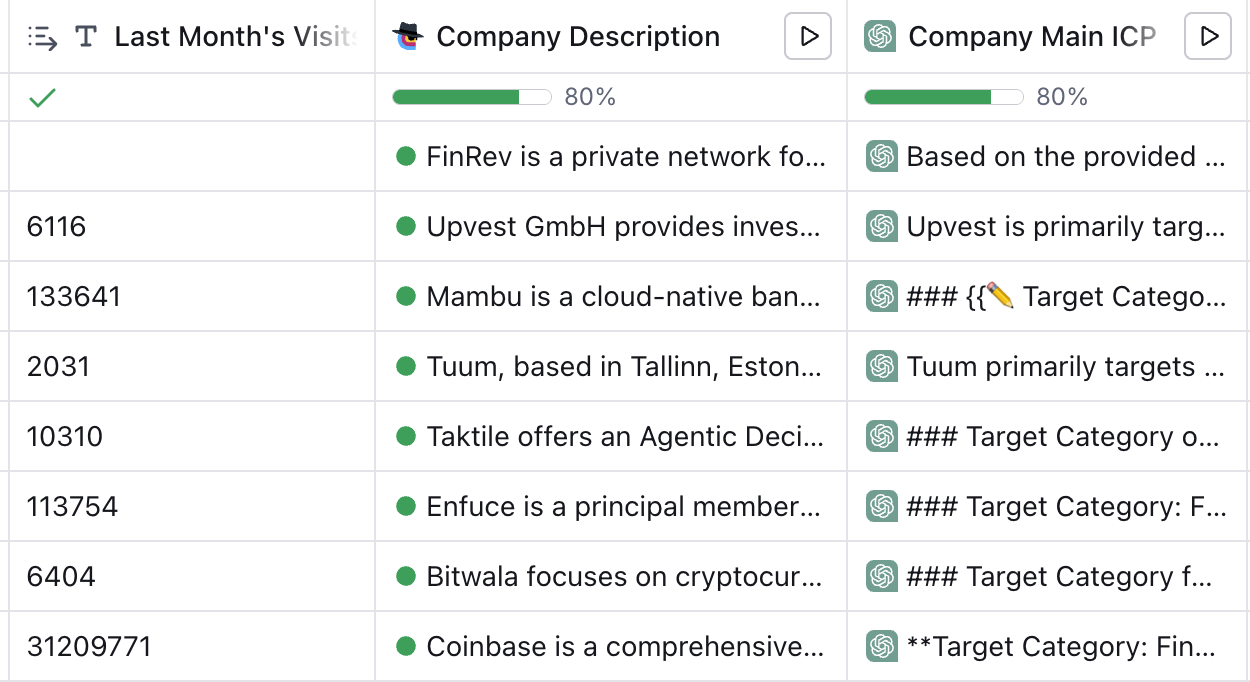
Step 3: Enrich Your CRM
The next step is integrating these insights into your CRM system, such as Salesforce or HubSpot.
Signals can enrich records at multiple levels:
Account level
- strategic initiatives
- product launches
- geographic expansion
Contact level
- leadership hires
- stakeholder profiles
Opportunity level
- signals indicating deal momentum
Your CRM becomes a living intelligence system, not just a database.

Step 4: Deliver Real-Time Alerts via Slack
While the CRM stores intelligence, sales teams often need immediate visibility.
This is where Slack becomes a powerful communication channel.
AI workflows can automatically post signals into Slack channels such as:
#account-intelligence
Example alert:
“Signal detected:
Fintech platform X has started hiring a team around embedded lending.
Three roles posted in the last two weeks.”
Or:
“Leadership update:
New Head of Payments joined Bank Y. Previously led payments modernization at fintech Z.”
This allows account executives to react quickly to developments inside their strategic accounts.
Step 5: Trigger Targeted Sales Engagement
Once a signal is identified, tools like Instantly or Lemlist can be used to initiate contextual outreach.
Instead of generic cold emails, messages reference real developments inside the account.
❗ Example: “Noticed you're building out a team around embedded lending. We’ve seen a number of SaaS platforms reach a similar stage where they begin evaluating lending infrastructure partners.”
Because the outreach references an active initiative, it tends to generate more relevant conversations.
The Modern Enterprise Sales Intelligence Stack
A simple AI-driven system for account intelligence might look like this:
End to End Sample Stack

Tailored Outreach Engine

Market Signal Analysis

💡TIP: Don’t over-do it with signals. Pick 3 to 5 meaningful ones, and build a solid action plan around them.
Clay:
Monitors signals across strategic accounts
↓
OpenAI / Claude
Interprets signals and extracts insights
↓
CRM (Salesforce / HubSpot)
Stores intelligence across accounts, contacts, and opportunities
↓
Slack
Delivers real-time alerts to sales teams
↓
Instantly / Lemlist
Enables contextual outreach and engagement
Final Thought
Enterprise fintech sales has always been about understanding your accounts better than your competitors.
In the past, building that level of insight required enormous amounts of manual research.
Today, AI allows sales teams to build continuous intelligence across their most important accounts, enabling them to identify buying cycles earlier and navigate complex deals more effectively.
Ready to get started?
In this session, we will:
- Identify your known and unknown challenges that hinder you from growing your business.
- Get solutions to your problems from GTM experts who’ve scaled high-growth B2B companies.
- Develop a 3-Step action plan that will get you results over the next 90 days.